

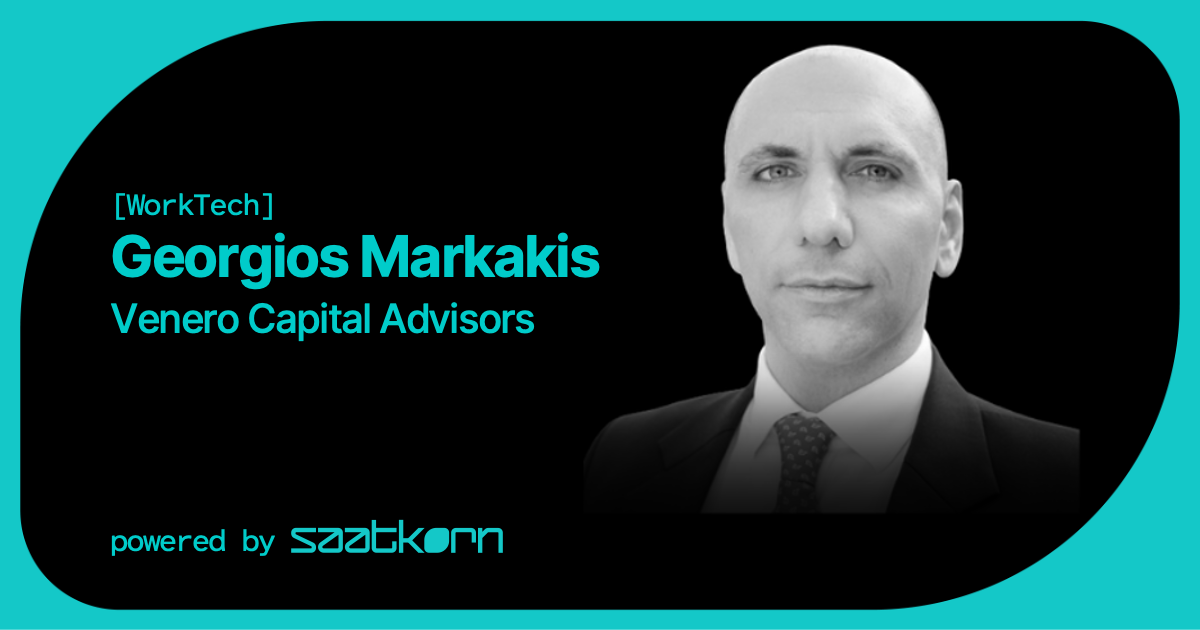
Venero Managing Partner Georgios Markakis sat down with Gero Hesse, CEO of EMBRACE and host of SAATKORN, one of the longest-running podcasts on HR and the world of work. Their conversation centred on Venero's latest Future of Work M&A and investment activity report, which identifies Q3 2026 as the busiest quarter for WorkTech M&A in our dataset.
A record quarter, but not a return to 2021
Venero tracked 131 WorkTech acquisitions in Q3 2026, up 49% on Q2 and well above the 88 to 117 deals per quarter seen over the previous three years. North America alone accounted for a record 70 transactions. Investment rose 165% to $5.9bn across 221 funding rounds, the highest quarterly total since Q2 2022.
As Georgios explains in the episode, the headline numbers don't signal a return to the conditions of 2021. The recovery is far more concentrated. Close to 80% of the capital raised in the quarter went to AI-native companies, and very few businesses are raising today without AI at the centre of their proposition. The result is a two-speed market: AI-native companies reshaping business models and the value they deliver to users, and companies that have not made that shift and are struggling to attract venture and private capital.
Incumbents are buying AI capability
The number of AI-native acquisition targets rose to 39 in Q3, compared with 13 a year earlier. Established platforms are increasingly acquiring AI capabilities rather than building everything in house. Georgios sees disruption across every category: analytics, workflow automation and recruitment most visibly, but also workforce management, learning and talent management, with core HR likely to follow sooner rather than later.
For the largest vendors, enterprise customers' reluctance to switch critical systems still offers a degree of protection, provided they keep pace with innovation. For mid-sized and early-stage companies, however, the game has changed radically.
The conversation also touched on SAP's acquisition of TechWolf, which fell outside the Q3 reporting period and will feature in our next report. Georgios described it as another example of why large corporates keep buying innovation they find hard to get right on their own.
Why talent acquisition slipped down the rankings
Talent acquisition has historically led the sector for consolidation and fundraising, and it remains active on a last-twelve-months basis. This quarter, though, productivity and workforce management software attracted more activity, as these are areas where AI particularly shines. In recruitment, AI has shifted the buy-versus-build equation: more companies now believe they can build functionality themselves, even if acquisitions often prove easier than building it right.
Data as the moat, and the rise of trust and verification
Venero called out data as the new moat several years ago, and that view has only strengthened. Investors and acquirers are looking for assets whose data is continuously generated and reused through the product, not just historical records.
Trust and verification is fast becoming critical infrastructure, particularly in recruitment. With near-perfect AI-written CVs, candidates reading from prompts in video interviews and the risk of deepfakes, being able to verify who you are speaking to and what their real skills are is becoming essential. Companies solving these problems, including background screening providers, are seeing growing interest.
Advice for HR leaders planning 2027
Georgios offered three recommendations for HR leaders evaluating technology investments:
- Keep an open mind and try the new capabilities. They can be very powerful, depending on the use case.
- Not everything needs an agent. Sometimes customers simply want their existing tools to work.
- Prepare for change to keep accelerating. The pace of innovation will not slow down, so staying on top of developments is essential.
Outlook: fast technology, cautious macro
Looking ahead, Georgios expects the pace of technological innovation to hold or accelerate, while the macro picture is more uncertain. Germany and France are already feeling the effects of a slowdown, and the US could face headwinds in 2027, potentially lasting a few quarters.
On productivity and employment, he expects the outcome to land somewhere in the middle: productivity will rise, but he does not anticipate a dramatic reduction in headcount.
A two-speed valuation market
What stood out most from this quarter's data was how clearly valuations have split. Undifferentiated assets without a moat are seeing their multiples compressed. High-quality, differentiated businesses with strong technology and KPIs, matched with the right acquirer or investor, continue to command strong valuations, as TechWolf and many other transactions show. We expect this divergence to persist over the coming quarters.
Listen to the full episode above or on SAATKORN.
Read Venero's full Q3 2026 Future of Work M&A and Investment Activity report here.
If you would like to discuss today's insights or explore how Venero can help your company determine its path forward, contact us.
Our thanks to Gero Hesse and the SAATKORN team for the conversation.





.webp)